
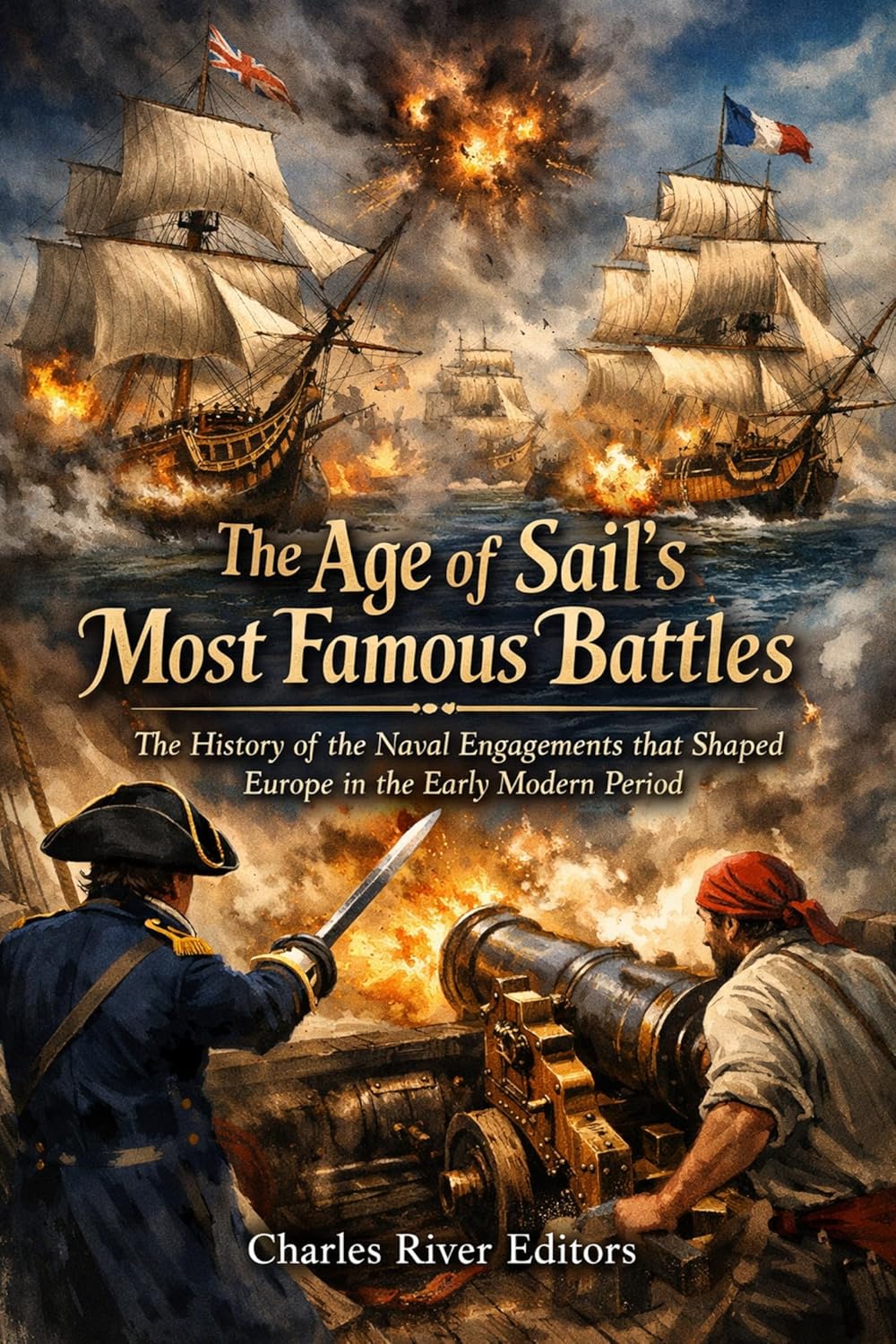
The Age of Sail’s Most Famous Battles: The History of the Naval Engagements that Shaped Europe in the Early Modern Period
Product details
| Management number | 232063018 | Release Date | 2026/06/18 | List Price | $90.00 | Model Number | 232063018 | ||
|---|---|---|---|---|---|---|---|---|---|
| Category | |||||||||
By the mid-15th century, the Byzantine Empire had collapsed and the various Crusades that had taken place in the region had largely disrupted the overland routes of the Silk Road and trade. Compounding the difficulties of trade was the rise of the Ottoman Empire in place of the Byzantines and the outbreak of the Black Death in Europe. It was roughly around this time that a period of European exploration began, and major factors that contributed to this period of exploration were introduced by the Chinese, albeit indirectly. The magnetic compass had already been developed and used by the Chinese sailors since the 12th century, although it had first been created in the 3rd century B.C. as a divination device. The Song Dynasty then began using the device for land navigation in the 11th century and sailors began using it shortly after. The technology slowly spread west via Arab traders, although a case can be made for the independent European creation for the compass. Regardless, by the 13th century the compass had found its way to Western traders, coming at a time that trade had been increasing across Europe.Trade was able to increase in Europe around the world due to more effective ships being introduced, and some of the improvements that were made to the ships were first introduced by the Chinese. The introduction of multiple mast ships and the sternpost rudders allowed the ships to travel quicker and be more maneuverable. By the start of the 15th century, ships were now much larger and able to support long-distance travel with a minimum number of crew aboard, fueling European imperialism across the globe. Maritime trade expanded on an unprecedented scale, bringing resources to and from Asia and the Americass, and even some powerful companies like the British East India Company raised capital from investors and operated with quasi-sovereign authority in far-flung regions.Of course, the various European powers, many of whom had already been fighting each other for generations, jockeyed for spices, gold, converts, and power across the seas, bringing about some of history’s most famous naval engagements and determining the fates of empires. The Battle of Lepanto was the last and largest great battle involving galleys - oared vessels that rammed and boarded enemy vessels - and also the first great naval conflict that effectively used cannons. It represented a clash for control of Europe between the Ottomans and Christian Europe, and it has long been held up by Christians as a crucial triumph for the West.On July 12, 1588, the legendary Spanish Armada headed for the English Channel. The Spanish plan was to take this invasion, led by the Duke of Parma, to the coast of southeast England, where they would be unleashed to conquer Elizabethan England for Spain’s King Philip II and Catholic Christendom. The Armada included over 150 ships, 8,000 sailors, and 18,000 soldiers, and it boasted a firepower of 1,500 brass guns and 1,000 iron guns. Just leaving port itself took the entire Armada two days, but as everyone who has been taught history now knows, the Armada was one of the most famous military debacles in history. Regardless of the debate over whether it was simple mathematical miscalculation or plain bad luck, coupled with English fire ships assailing the Spanish ships, the Armada was decisively defeated. That defeat would allow England to establish itself as a maritime in the 16th century.As the Royal Navy became the most powerful fighting force on the high seas, the British Empire leaned heavily on it to maintain its global standing, so it is no surprise that Britain’s most famous military hero is Admiral Lord Horatio Nelson. Read more
| ASIN | B0GPSPSZRY |
|---|---|
| XRay | Not Enabled |
| Language | English |
| File size | 44.9 MB |
| Page Flip | Enabled |
| Publisher | Charles River Editors |
| Word Wise | Enabled |
| Print length | 258 pages |
| Accessibility | Learn more |
| Screen Reader | Supported |
| Publication date | February 24, 2026 |
| Enhanced typesetting | Enabled |
Bestseller ranking
Children's Immunity Support






Customers who viewed this product also viewed
Naval


Correction of product information
If you notice any omissions or errors in the product information on this page, please use the correction request form below.
Correction Request Form